Thursday, March 7, 2024

Behavioral Finance, a Quantitative Approach to the Secondary Market

In the coming series of articles, I aim to unveil the culmination of an intensive and thorough research journey that I embarked on during my pursuit of a master's degree in finance, accounting, and financial technology. Over the span of almost a year, this thesis serves as a testament to the depth and breadth of my exploration into the behavioral dynamics and qualitative methodologies that influence the secondary market.

With a keen focus on unraveling the intricate psyche of investors within the stock market, this study ventures beyond mere quantitative analysis to explore the nuanced behavioral underpinnings driving market movements. Drawing upon the expertise of eminent scholars such as Malcom Baker and Jeffrey Wurgler, this research delves into the inner workings of investor decision-making processes, shedding light on the subtle yet profound influences that shape market behaviors.

Through a meticulous examination of various behavioral theories and qualitative frameworks, this thesis endeavors to offer novel insights into the complexities of the secondary market. By synthesizing theoretical paradigms with empirical observations, it seeks to bridge the gap between academic research and real-world application, providing invaluable perspectives for practitioners and scholars alike.

As we navigate through the intricate terrain of financial markets, understanding the behavioral nuances that govern investor actions becomes increasingly paramount. This thesis serves as a comprehensive exploration into the behavioral dimensions of the secondary market, paving the way for deeper insights, informed decision-making, and ultimately, a more nuanced understanding of the ever-evolving financial landscape.

In the upcoming posts, I am excited to unveil and delve deeper into my latest endeavors. Join me as I share the culmination of my efforts, offering insights, discoveries, and perhaps even a touch of inspiration along the way.
Wednesday, July 19, 2023

“Behavioral Finance, a quantitative approach to the secondary market”

The below abstract belongs to “Behavioral Finance, a quantitative approach to the secondary market” thesis.

Abstract

The influence of investor sentiment on asset prices is known to deviate them from their equilibrium level determined by underlying fundamentals. Understanding and analyzing sentiment, even though it cannot be directly measured or observed, holds significant importance as it enables the identification of appropriate substitutes or proxies that can effectively represent and gauge sentiment's influence on asset prices. By finding reliable indicators or measures that are indicative of prevailing sentiment, analysts and investors can gain valuable insights into market dynamics and make informed decisions. When asset prices fail to accurately reflect their fundamental values, it can lead to an inefficient allocation of capital, affecting portfolio allocation decisions and the cost of capital.

In the current study, we adopt a quantitative behavioral approach to model the impact of investor behavior in the stock market. We test two hypotheses based on different time periods: one using actual values and the other based on the difference between the current period (t) and the previous period (t-1). By employing various sentiment proxies and examining data from 2000 to 2022, we establish a weak relationship between investor sentiment and stock returns, which aligns with theoretical explanations of sentiment.

The methodology focuses on the behavior of the retail stock market participants, considering both the current return and the change of the S&P 500. To validate our findings, we compare our model with other well-known indexes such as VIX, UMICH, and AAII. This comparison aims to ascertain the effectiveness of the model proposed in this paper in accurately reflecting investor sentiment in market returns, closely mirroring real-world conditions.

Keywords: Behavioral Economics, Investor sentiment, Financial markets, Stock markets

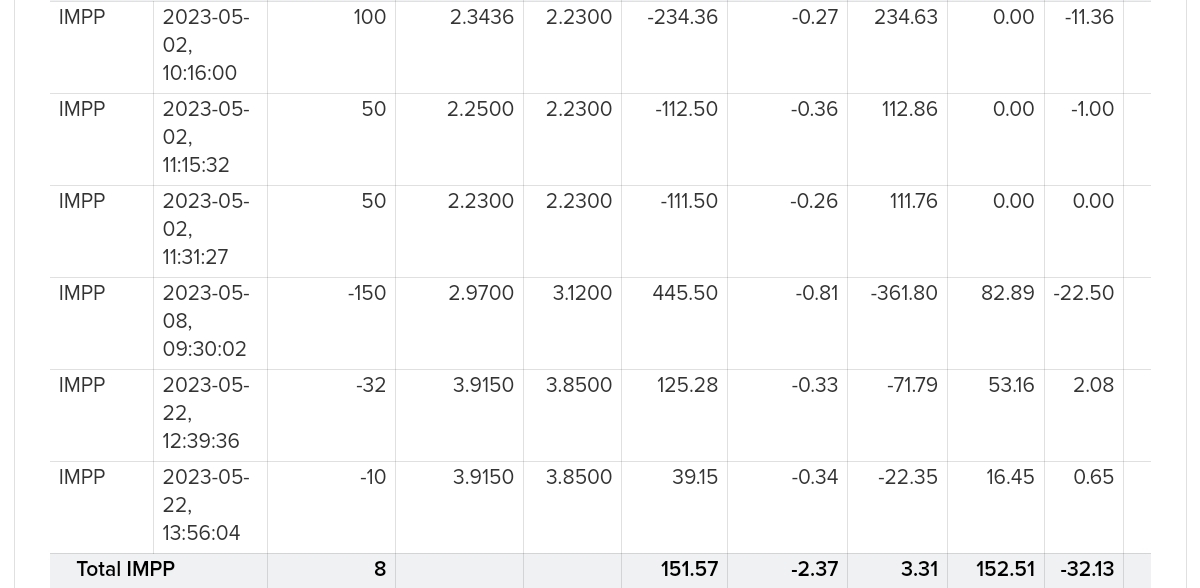
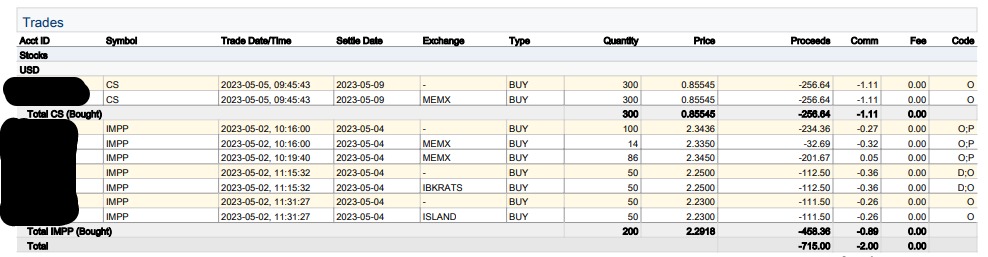
IMPP profit

In June 2023, IMPP stock surged over 344% in a month. This was due to a number of factors, including rising oil prices and the company's acquisition of a new oil field.
The future of IMPP stock is uncertain. However, the company has a number of factors in its favor, including rising oil prices and its acquisition of a new oil field. If these factors continue to support the company, IMPP stock could continue to rise in the future.

However, there are also some risks to consider. The global economy is facing a number of challenges, and these could impact the demand for oil. If demand for oil falls, it could hurt IMPP's bottom line and could lead to a decline in the stock price. My personal approach was to dump the stock and instead Invest to the Ai hype.

Saturday, May 6, 2023

IMPP IMPERIAL PETROLEUM INC

IMPERIAL PETROLEUM INC had a great day on the market, as its shares rose by 12% to close at $45.67. The company reported strong earnings for the first quarter of 2023, beating analysts' expectations. 

The oil and gas producer also announced plans to expand its operations in the Middle East and Africa, where it sees high demand and low costs. Investors were impressed by the company's performance and outlook, and rewarded it with a higher valuation.


Wednesday, March 15, 2023

Buying big banks bonanza

Today's result after big banks discount. Did the collapse of SVB had a contribution to the overall downfall of the banking sector or it was only the CPI and PMI strong numbers that played a major role?

Sunday, March 12, 2023

Silicon Valley Bank, reason behind the default

Silicon Valley Bank is the largest bank to fail since the 2008 financial crisis. The primary reason for the failure of SVB was their choice to invest their customers' deposits in treasury bonds, which are highly impacted by shifts in interest rates. 

It bought government bonds with fixed interest rates and as the Fed raised rates, those bonds lost value. Silicon Valley Bank had $80 billion in bonds with an average yield of 1.5%. No one wants bonds yielding 1.5% when the current market is selling bonds with yields over 5%.

Friday, January 13, 2023

Big Banks earning show in one graph.

Graph and numbers of top Big Banks earnings and % price for the first quarter of 2023,


C:
in USD
Actual
Estimate
Beat/Miss
Revenue
18.0B
18.0B
+0.2%
EBIT
5.02B
5.07B
-1.0%
EPS
1.16
1.20
-3.5%

JPM:
in USD
Actual
Estimate
Beat/Miss
Revenue
34.5B
34.2B
+0.9%
EBIT
15.5B
14.2B
+9.0%
EPS
3.57
3.10
+15.0%

WFC:
in USD
Actual
Estimate
Beat/Miss
Revenue
19.7B
20.0B
-1.9%
EBIT
3.46B
5.04B
-31.4%
EPS
1.45
1.10
+32.6%

BAC:
in USD
Actual
Estimate
Beat/Miss
Revenue
24.5B
24.2B
+1.5%
EBIT
8.99B
8.77B
+2.5%
EPS
0.85
0.77
+10.9%

Popular Posts: