Tuesday, March 12, 2024

What normal investing looks like

In the ever-fluctuating theatre of the financial markets, my portfolio has emerged as a paragon of growth, boasting a commendable year-to-date performance with a 7.87% increase.

This uptick is not merely a number—it is a testament to strategic acumen and an unerring foresight in asset allocation. Amidst economic ebbs and flows, the investment collection has not only weathered the storm but has also charted a course through the tempest to safe harbor, reflecting both resilience and the potential for sustained prosperity. As we look towards the horizon, this robust ascent augurs well for the continued financial health and vitality of the portfolio. 

Thursday, March 7, 2024

Sentiment and the Market: A Visual Analysis

Chart 1: Sentiment Index

This chart tracks a sentiment index, likely constructed from various market indicators and news sentiment analysis. The period circled, coinciding with the COVID-19 pandemic, shows a sharp decline in sentiment, reflecting the uncertainty and fear that gripped the markets during that time.

Chart 2: S&P 500 & VIX 

This chart juxtaposes the S&P 500 index, a broad measure of the U.S. stock market, with the VIX, often referred to as the "fear index."
  • S&P 500: The circled area highlights a period of rapid growth in the S&P 500, likely fueled by market optimism.
  • VIX: Conversely, the VIX shows a decline during this period, indicating decreased fear and volatility in the market. The annotation "reversed behavior" suggests an inverse relationship between the two, which is typical as lower volatility often accompanies rising markets.

Chart 3: University of Michigan Consumer Sentiment & AAII Bull-Bear Ratio

This chart compares two sentiment indicators:
  • University of Michigan Consumer Sentiment: This widely followed index reflects consumer confidence in the economy. The circled area shows a dip in sentiment, possibly corresponding to an economic downturn or period of uncertainty.
  • AAII Bull-Bear Ratio: This indicator measures the ratio of bullish investors to bearish investors. The circled area suggests a period where bearish sentiment dominated, aligning with the dip in consumer sentiment.

Sneak peak of the Market sentiment indicator, sneak peak

Measuring investor sentiment is a complex task, but there is no real obstacle to identifying imprecise indicators that retain their utility over time. To this end, we examine a number of general considerations in the process of measuring investment sentiment and examine the proxy indicators that have been adopted for this purpose.

Various models have been developed to measure investor sentiment, but some of these models may contain idiosyncratic components unrelated to sentiment. For example, the liberalization of stock trading fees in 1975 and the subsequent long reduction in trading costs led to a ten-year stock market uptrend, so using the percentage difference in returns will eliminate the idiosyncratic component of the price index.

Sentiment index

Behavioral Finance, a Quantitative Approach to the Secondary Market

In the coming series of articles, I aim to unveil the culmination of an intensive and thorough research journey that I embarked on during my pursuit of a master's degree in finance, accounting, and financial technology. Over the span of almost a year, this thesis serves as a testament to the depth and breadth of my exploration into the behavioral dynamics and qualitative methodologies that influence the secondary market.

With a keen focus on unraveling the intricate psyche of investors within the stock market, this study ventures beyond mere quantitative analysis to explore the nuanced behavioral underpinnings driving market movements. Drawing upon the expertise of eminent scholars such as Malcom Baker and Jeffrey Wurgler, this research delves into the inner workings of investor decision-making processes, shedding light on the subtle yet profound influences that shape market behaviors.

Through a meticulous examination of various behavioral theories and qualitative frameworks, this thesis endeavors to offer novel insights into the complexities of the secondary market. By synthesizing theoretical paradigms with empirical observations, it seeks to bridge the gap between academic research and real-world application, providing invaluable perspectives for practitioners and scholars alike.

As we navigate through the intricate terrain of financial markets, understanding the behavioral nuances that govern investor actions becomes increasingly paramount. This thesis serves as a comprehensive exploration into the behavioral dimensions of the secondary market, paving the way for deeper insights, informed decision-making, and ultimately, a more nuanced understanding of the ever-evolving financial landscape.

In the upcoming posts, I am excited to unveil and delve deeper into my latest endeavors. Join me as I share the culmination of my efforts, offering insights, discoveries, and perhaps even a touch of inspiration along the way.

Wednesday, July 19, 2023

“Behavioral Finance, a quantitative approach to the secondary market”

The below abstract belongs to “Behavioral Finance, a quantitative approach to the secondary market” thesis.

Abstract

The influence of investor sentiment on asset prices is known to deviate them from their equilibrium level determined by underlying fundamentals. Understanding and analyzing sentiment, even though it cannot be directly measured or observed, holds significant importance as it enables the identification of appropriate substitutes or proxies that can effectively represent and gauge sentiment's influence on asset prices. By finding reliable indicators or measures that are indicative of prevailing sentiment, analysts and investors can gain valuable insights into market dynamics and make informed decisions. When asset prices fail to accurately reflect their fundamental values, it can lead to an inefficient allocation of capital, affecting portfolio allocation decisions and the cost of capital.

In the current study, we adopt a quantitative behavioral approach to model the impact of investor behavior in the stock market. We test two hypotheses based on different time periods: one using actual values and the other based on the difference between the current period (t) and the previous period (t-1). By employing various sentiment proxies and examining data from 2000 to 2022, we establish a weak relationship between investor sentiment and stock returns, which aligns with theoretical explanations of sentiment.

The methodology focuses on the behavior of the retail stock market participants, considering both the current return and the change of the S&P 500. To validate our findings, we compare our model with other well-known indexes such as VIX, UMICH, and AAII. This comparison aims to ascertain the effectiveness of the model proposed in this paper in accurately reflecting investor sentiment in market returns, closely mirroring real-world conditions.

Keywords: Behavioral Economics, Investor sentiment, Financial markets, Stock markets

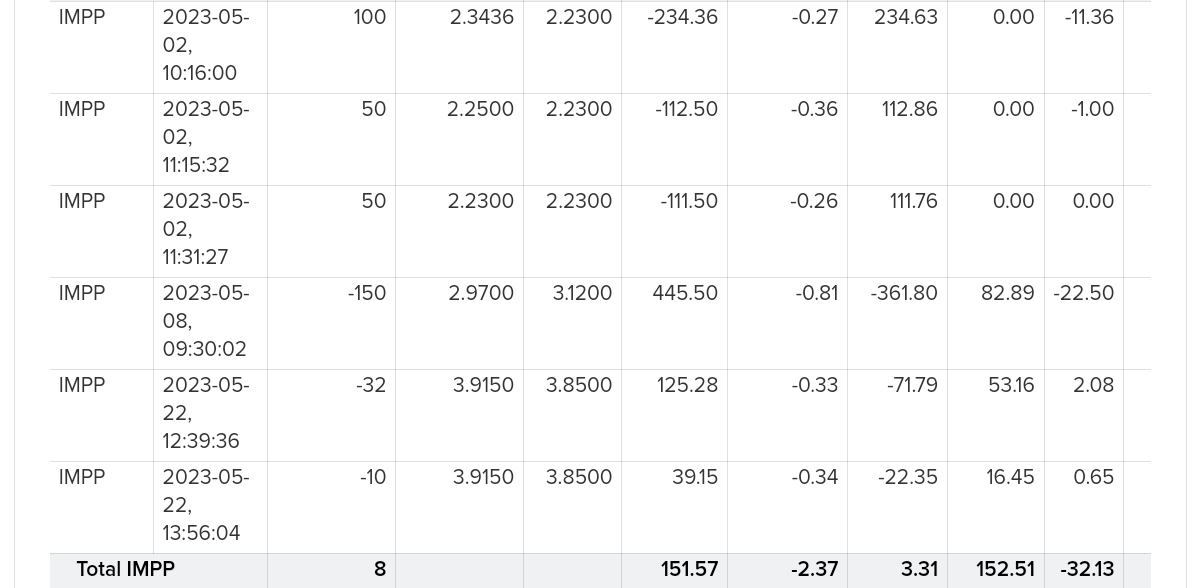
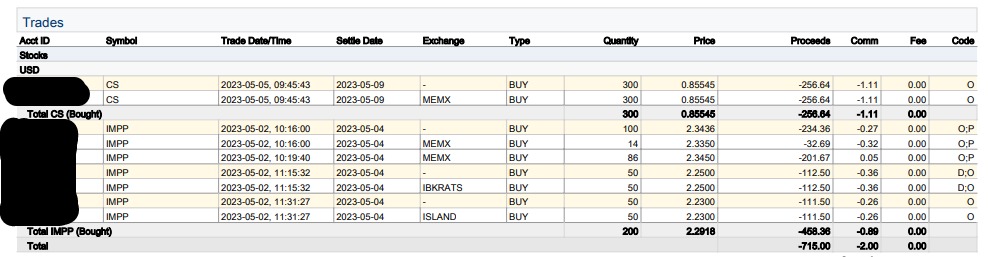
IMPP profit

In June 2023, IMPP stock surged over 344% in a month. This was due to a number of factors, including rising oil prices and the company's acquisition of a new oil field.
The future of IMPP stock is uncertain. However, the company has a number of factors in its favor, including rising oil prices and its acquisition of a new oil field. If these factors continue to support the company, IMPP stock could continue to rise in the future.

However, there are also some risks to consider. The global economy is facing a number of challenges, and these could impact the demand for oil. If demand for oil falls, it could hurt IMPP's bottom line and could lead to a decline in the stock price. My personal approach was to dump the stock and instead Invest to the Ai hype.

Saturday, May 6, 2023

IMPP IMPERIAL PETROLEUM INC

IMPERIAL PETROLEUM INC had a great day on the market, as its shares rose by 12% to close at $45.67. The company reported strong earnings for the first quarter of 2023, beating analysts' expectations. 

The oil and gas producer also announced plans to expand its operations in the Middle East and Africa, where it sees high demand and low costs. Investors were impressed by the company's performance and outlook, and rewarded it with a higher valuation.


Popular Posts: